

Contributed by:Name – Priya Singh
Email – priya@simplybiz.in
1. Introduction
In the modern corporate environment, success is no longer measured solely by profits, expansion, or market share. The true strength of an organisation lies in its ability to maintain transparency, accountability, and stakeholder trust. Companies that fail in governance often collapse not because of weak performance but because of ethical lapses.
This is where Independent Directors (IDs) play a crucial role. Positioned within the Board but independent of management and promoters, they act as neutral decision-makers who ensure fairness and integrity in corporate functioning. Recognised under the Companies Act, 2013, Independent Directors are now a statutory necessity for certain class of companies, forming the backbone of effective corporate governance in India.
2. Meaning of Independent Director
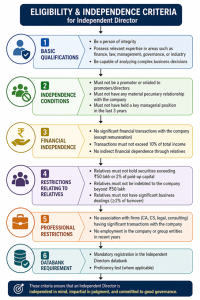
As per Section 149(6) of the Companies Act, 2013, an Independent Director is a director other than a Managing Director, Whole-Time Director, or Nominee Director, who possesses integrity, expertise, and independence of judgment.
An Independent Director is defined more by exclusion:
- Not involved in day-to-day operations
- Not related to promoters or management
- Not financially dependent on the company
- Not influenced by internal hierarchy
This independence allows them to bring objectivity, fairness, unbiased judgment and the ability to express dissenting views in boardroom decisions.
3.Company Law Provisions and Limits
A. Mandatory Appointment (Section 149)
Listed companies – at least one-third of the total Board strength
Unlisted Public company (if threshold crosses – Minimum requirement as mentioned below): Two Independent Directors on the Board
| Category of Company | Requirement of Independent Directors |
| Paid-up Capital | ≥ ₹10 crore |
| Turnover | ≥ ₹100 crore |
| Loans / Deposits / Debentures | ≥ ₹50 crore |
- Where a company ceases to fulfil any of the three conditions laid down above for three consecutive years, it shall not be required to appoint independent directors until such time as it meets any of such conditions.
- These thresholds as existing on the last date of latest audited financial statements shall be taken into account for the purpose of triggering the applicability of section 149(4) of the Act. Any company which crosses these thresholds at any time after the commencement of the Act, needs to appoint independent directors immediately as there is no transition period now available.
B. Tenure Limits
| Particulars | Provision |
| Term of Appointment | Up to 5 years |
| Reappointment | Eligible for 1 more term (5 years) |
| Maximum Tenure | 10 consecutive years |
| Cooling-off Period | 3 years (no association with the company) |
C. Appointment,Compliance & Remuneration
The Central Government has notified that the Indian Institute of Corporate Affairs shall create and maintain a data bank containing names, addresses and qualifications of persons who are eligible and willing to act as independent directors, for the use of the company making the appointment of such directors. The broad steps for appointment would include:
- Shareholders’ approval for the appointment by passing an Ordinary Resolution
- Declaration of independence to be provided at the First Board Meeting
- Independent Directors must comply with Schedule IV Code of Conduct
- They must participate in familiarisation programmes
Remuneration of Independent Directors
- Independent Directors are not entitled to stock options.
- They cannot receive remuneration other than:
- Sitting fees for Board and Committee meetings; and
- Profit-related commission within the limits prescribed under Section 197 of the Companies Act, 2013.
- Payment of profit-related commission is subject to shareholders’ approval.
In addition, independent directors are entitled to get reimbursement of expenses incurred by them for the purpose of participation in the meetings. The expenses may relate to travelling, accommodation, etc. in connection with activities of the company.
D. Role in Committees
Independent Directors are key members of:
- Audit Committee
- Nomination & Remuneration Committee
- Stakeholders Relationship CommitteeRisk Management Committee
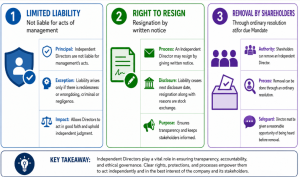
E. Liability, Resignation and Removal
F. Directors and Officers(D&O) insurance
D&O Insurance protects directors and officers against legal liabilities and claims arising from decisions and actions taken while performing their duties.
SEBI Listing Regulations mandate D&O Insurance for:
- Top 1000 listed companies by market capitalization; and
- High value debt listed entities.
The insurance must cover all Independent Directors. The Board of Directors determines:
- Quantum of insurance coverage; and
- Risks to be covered.
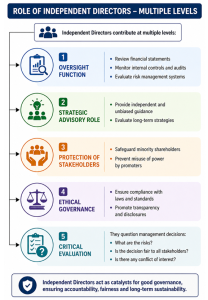
4. Importance in Today’s Corporate World
Independent Directors:
- Reduce promoter dominance
- Strengthen financial integrity
- Improve transparency
- Encourage long-term decision-making
- Enhance investor confidence
Their presence ensures that corporate decisions are scrutinised, balanced and accountable.
5. Case Studies: Corporate Governance in Practice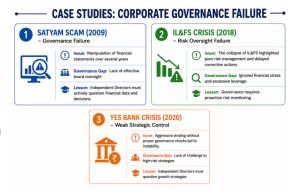


6. Evolution of Corporate Governance in India
Earlier, corporate governance in India was largely promoter-driven, where key decisions were concentrated in the hands of controlling shareholders and Independent Directors had only a limited and often symbolic role. Governance practices existed more in form than in substance, with Boards functioning largely as approval bodies rather than active decision-makers.
However, the introduction of the Companies Act, 2013 marked a significant shift in this landscape. The mandatory inclusion of Independent Directors brought in greater accountability and transparency, transforming boardrooms into spaces of active deliberation. Today, Independent Directors play a critical and participative role in decision-making, ensuring that corporate actions are not only compliant but also fair, balanced, and aligned with long-term stakeholder interests.
Conclusion: The Conscience of Corporate Governance
Independent Directors may not manage companies, but they influence how companies are managed. They serve as the bridge between power and accountability, ensuring that business decisions are ethical and sustainable.
A company without strong Independent Directors risks governance failure, while a company with effective Independent Directors builds trust, stability, and long-term success.
In essence, Independent Directors represent:
- Accountability over authority
- Oversight over management
- Ethics over expediency
They are not just Board members—they are the guardians of corporate integrity and trust.
If your organization is looking to strengthen its corporate governance framework and ensure effective compliance practices, SimplyBiz can help.
For assistance on corporate governance, Board processes, and compliance advisory, feel free to reach out to Vaishali Vohra at vaishali@simplybiz.in, Vanaja at vanaja@simplybiz.in.
Leave A Comment