

Contributed by: Seema Gupta
Email – seemagupta@simplybiz.in
1. Introduction
The Companies Act, 2013 introduced the concept of a Resident Director under Section 149(3) of the Companies Act, 2013 as part of its broader corporate governance framework. It mandates that every Company must have at least one director who stays in India for not less than 182 days during the financial year, ensuring regulatory accessibility, compliance oversight, and accountability through the presence of a responsible individual within India.
The requirement assumes particular significance for multinational groups and foreign-owned subsidiaries being set up as GCCs in India whose directors are predominantly based outside India.
Despite the seemingly straightforward nature of Section 149(3), an important practical question arises in corporate compliance circles: Can a Director be regarded as a Resident Director merely because he satisfied the 182-day residency requirement in the preceding financial year, or must the requirement be satisfied during the financial year for which compliance is being assessed under Section 149(3)?
2. Legislative Background and Evolution of Section 149(3)
A. Original Provision
Originally, Section 149(3) required every Company to have at least one director who has stayed in India for not less than 182 days in the previous calendar year.
B. Amendment by the Companies (Amendment) Act, 2017
With effect from 7th May 2018, the provision was amended to require a director who stays in India for not less than 182 days during the financial year. Simultaneously, a proportionate compliance requirement was introduced for newly incorporated companies.
C. Significance of the Amendment and Practical Implications:
The amendment introduced three notable changes:
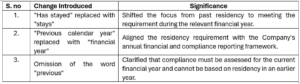
The 2017 amendment to Section 149(3) transformed the resident director requirement from a historical residency test based on a preceding period into a financial-year-specific compliance obligation. Accordingly, every company must ensure that at least one director stays in India for a minimum of 182 days during the relevant financial year. Such stay need not be continuous, and the 182 days are to be computed on a cumulative basis.
 D. Practical Implications for Companies
- Foreign-Owned Subsidiaries: Since the Boards of foreign-owned subsidiaries are often dominated by overseas Executives, these companies should periodically review the residency status of their directors to avoid inadvertent non-compliance.
- Overseas Promoter Directors: Companies relying on overseas promoters/executives as Resident Directors should periodically monitor their physical presence in India to avoid an unintended breach of the resident director requirement.
- Board Succession Planning: Resignation, relocation, or prolonged absence of an existing resident director may require immediate corrective action to maintain compliance.
3. Why Resident Director Compliance is a Year-by-Year Requirement
The deliberate removal of the word “previous” from Section 149(3) demonstrates the legislature’s intention to move away from a retrospective residency test. If compliance were determined based on a previous year’s residency, a director with limited presence in India during the current year could still be treated as a Resident Director, which would defeat the purpose of the provision.
Therefore, the more consistent interpretation is that at least one director must satisfy the 182-day residency requirement during the financial year under review.
4.MCA Circulars and Regulatory Interpretation
The Ministry of Corporate Affairs (MCA), through General Circular Nos. 11/2020 and 36/2020, granted relaxation from the minimum residency requirement for FY 2019-20 and FY 2020-21 due to disruptions caused by the COVID-19 pandemic. This relaxations for specific financial years further support the view that compliance under Section 149(3) is assessed year-wise.
5.Consequences of non-compliance
Non-compliance with Section 149(3) attracts the general penalty provisions under Section 172 of the Companies Act, 2013. The Company and every officer in default are liable to a penalty of ₹50,000, and in case of a continuing default, a further penalty of ₹500 per day, subject to a maximum of ₹3,00,000 in case of the Company and ₹1,00,000 in case of each officer in default.
The seriousness of the requirement was reaffirmed in the ROC Bengaluru Adjudication Order No. PO/ADJ/03-2026/BL/01724 dated 9th March 2026 in the matter of Indo-MIM Limited, where prolonged non-compliance resulted in the imposition of the maximum statutory penalty on the Company and its Directors.
6. Illustrative
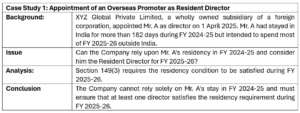
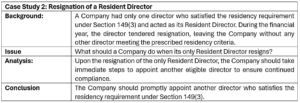
7. Eligibility and Appointment of a Resident Director
The Companies Act, 2013 does not restrict the resident director role by nationality or citizenship. Any individual, whether an Indian citizen, Non-Resident Indian (NRI), or foreign national, can be appointed as a Resident Director, provided he or she satisfies the requirement of staying in India for at least 182 days during the relevant financial year. The appointment is made in the same manner as any other director under the Companies Act, 2013, and no separate MCA filing or registration is prescribed for Resident Director status.
8. Practical Tips to Maintain Resident Director Compliance
- Track travel dates: Maintain and periodically review directors’ travel records to ensure compliance with the 182-day requirement.
- Plan for contingencies: If the resident director is likely to stay abroad for a prolonged period, consider appointing an additional eligible director.
- Monitor NRI Director: NRI directors should carefully track their days of stay in India to avoid falling short of the prescribed threshold.
- Keep passport records: Passport entry and exit stamps are the primary evidence of physical presence in India. For directors who travel via e-visa or countries where stamps are not issued on every visit, maintain airline booking records and hotel receipts.
- Have a Backup Option: For companies with internationally mobile founders, having two directors who qualify (or are likely to qualify) as resident directors in any given year provides a compliance safety net if one director’s India presence falls short.
9.Conclusion
The Resident Director requirement under Section 149(3) is a non-negotiable Statutory obligation applicable to every Company incorporated in India. Following the 2017 amendment, compliance must be assessed with reference to each Financial Year, requiring at least one Director to stay in India for a minimum of 182 days during the relevant Financial Year. Accordingly, companies cannot rely on residency achieved in a previous year and should continuously monitor the residency status of their directors, maintain appropriate records, and take timely corrective action to ensure uninterrupted compliance and sound corporate governance.
If you want to know more on the Resident Director for GCCs Setting Up in India related requirements, please write to our Director – Compliance & Strategy – Vaishali Vohra at the mail ID vaishali@simplybiz.in,VP – Corporate Compliances at vanaja@simplybiz.
Leave A Comment