
Contributed by – Athira Ramesh
Email – athira@simplybiz.in
Executive Summary
The Companies Act, 2013 fundamentally transformed corporate governance in India by codifying directors’ duties under Section 166 and delineating board powers under Section 179. For corporate secretarial practitioners, understanding how legal teams structure internal policies including Directors and Officers (D&O) insurance, training protocols, and disclosure frameworks to mitigate personal liability constitutes what we term the “Fiduciary Gold Standard.”
I. The Legislative Framework: Sections 166 and 179
Section 166: The Fiduciary Imperative
Section 166 establishes a comprehensive framework of fiduciary obligations. Directors must act in accordance with the company’s Articles of Association, ensuring all actions align with the governance framework established by shareholders. The duty to act in good faith requires directors to perform functions with honesty, integrity, and transparency while promoting the company’s objectives for the benefit of members, employees, shareholders, community, and environment marking a significant departure from shareholder primacy toward stakeholder capitalism.
Directors must exercise due and reasonable care, applying appropriate skill and diligence while maintaining independent judgment free from undue influence. This duty is measured against what a reasonably prudent person would do in similar circumstances. The prohibition against conflicts of interest demands that directors avoid situations creating actual or potential conflicts between personal and company interests. Directors must not achieve undue gain for themselves, relatives, partners, or associates. The office is personal and non-assignable, ensuring accountability remains with the appointed individual. Failure to comply carries penalties ranging from INR 100,000 to INR 500,000.
A critical jurisprudential ambiguity persists: whether Section 166’s codification has completely supplanted common law principles or whether these remain operative. Unlike UK and Singapore statutes, India’s Act contains no express provision preserving common law principles. This interpretive gap necessitates conservative approaches in structuring internal policies, assuming broader rather than narrower liability exposure.
Section 179: Delineation of Board Powers
Section 179 establishes a framework where the Board exercises all powers the company is authorized to exercise, subject to Act provisions, memorandum, articles, and general meeting regulations. Certain critical powers must be exercised exclusively through board resolutions, including making calls on shareholders, authorizing buy-backs, issuing securities, borrowing beyond prescribed limits, investing company funds, and granting loans or guarantees. This mandatory board-level approval serves as a procedural safeguard for significant corporate decisions.
The legislation permits strategic delegation of certain powers to committees, managing directors, managers, or principal officers through formal resolutions. This framework enables operational efficiency while maintaining accountability through documented authority matrices, providing procedural shields when decisions are taken within prescribed frameworks.
II. D&O Insurance: First-Line Defense
Coverage Architecture
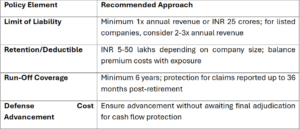
Currently, D&O insurance is not legally mandatory except for independent directors of listed companies under SEBI regulations. However, it has evolved into a governance imperative. The insurance operates through three coverage layers: Side A protects individual directors when the company cannot indemnify them; Side B reimburses the company for indemnification payments; and Side C protects the company itself for securities claims.
Coverage extends to breach of duty, breach of trust, negligence, errors and omissions, misrepresentation, legal defense costs, settlements, regulatory investigation expenses, crisis management, and employment practices liability. Critical exclusions include known circumstances, prior litigation, bodily injury, property damage, fraudulent or criminal acts, and pollution-related liabilities.
Strategic Policy Structuring
III. Training Protocols: Building the Knowledge Defense
While the Act does not mandate specific training hours for all directors, comprehensive training serves multiple strategic purposes: demonstrating due diligence through documented programs, creating early warning systems for compliance gaps, and supporting business judgment rule application by courts when directors demonstrate specialized knowledge.
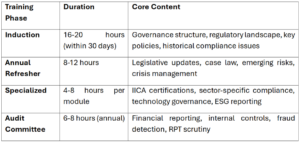
Effective programs require robust documentation: detailed attendance registers with signatures, pre- and post-training assessments, materials retention for seven years, annual director certifications, and integration with evaluation frameworks.
IV. Disclosure Protocols: The Transparency Shield
Related Party Transaction Framework
Section 188 requires board approval before entering RPTs, with comprehensive agenda disclosures including related party identification, relationship nature, contract terms, transaction value, advances, pricing methodology, and arm’s length evaluation. This transforms opaque transactions into transparent, documented decisions.
Comprehensive Disclosure Systems
Companies should implement structured declaration frameworks requiring annual comprehensive interest disclosures, transactional declarations before each board meeting, and immediate disclosure within seven days of changed circumstances. Digital systems with complete audit trails ensure consistent, verifiable compliance.
Statutory registers must document all RPT particulars in prescribed formats, updated contemporaneously with approvals. Financial statements must include extensive disclosures per Ind AS 24: relationship nature, transaction amounts, outstanding balances, terms and conditions, provisions for doubtful debts, and separate disclosure by related party category.
Vigil Mechanism
The Section 177 vigil mechanism promotes ethical governance and early detection of irregularities. Effective implementation requires multiple reporting channels (dedicated email, physical drop boxes, third-party hotlines), robust protection against retaliation, defined investigation protocols with independent committees, and quarterly reporting to audit committees detailing complaints, investigations, and corrective actions.
V. Integrated Risk Management: The Three-Pillar Model
Preventive Controls establish expectations before problems arise through comprehensive training, robust disclosure frameworks, clear delegation matrices, and policy documentation. Detective Controls identify problems early through internal audits focused on compliance, board evaluations, external compliance audits, and continuous monitoring systems. Corrective Mechanisms provide protection through D&O insurance, indemnification provisions in Articles, crisis management teams, and remediation protocols.
The corporate secretary serves as architect-in-chief, responsible for policy development, training coordination, compliance monitoring, insurance management, comprehensive documentation, and real-time board advisory on governance matters.
VI. Emerging Trends
Digital governance offers blockchain-based disclosure systems for immutable record-keeping and AI-powered compliance monitoring for real-time risk identification. However, cyber risk insurance becomes essential as boards face liability for inadequate cyber security oversight.
ESG integration transforms Section 166(2)’s stakeholder approach into operational requirements: climate risk governance, supply chain due diligence, human rights impact assessments, and sustainability reporting through BRSR, TCFD, and GRI frameworks.
For companies with international operations, cross-border D&O insurance must cover multiple jurisdictions, while governance frameworks must satisfy layered obligations across regulatory regimes including Companies Act, SOX, GDPR, SEC rules, and SEBI regulations.
VII. Conclusion
The Fiduciary Gold Standard represents strategic transformation of governance from compliance cost center to value driver. By systematically structuring policies around insurance protection, training protocols, and disclosure mechanisms, companies create defensive moats against liability claims, operational excellence through clear processes, stakeholder confidence demonstrating governance commitment, regulatory goodwill through proactive compliance, and talent attraction to well-governed entities.
For corporate secretarial professionals,mastering the interplay between Sections 166 and 179 and translating statutory mandates into practical protective mechanisms represents the essence of value creation. The Gold Standard is not a destination but a continuous journey of refinement, adaptation, and excellence using governance as strategic differentiator in an increasingly complex business environment where companies that embed these principles into organizational DNA will not merely survive but thrive.
For expert guidance on strengthening fiduciary governance and mitigating personal liability through strategic internal policies, connect with our team at shilpa@simplybiz.in.
Leave A Comment