
Contributed by – Athira Ramesh
Email – athira@simplybiz.in
Introduction
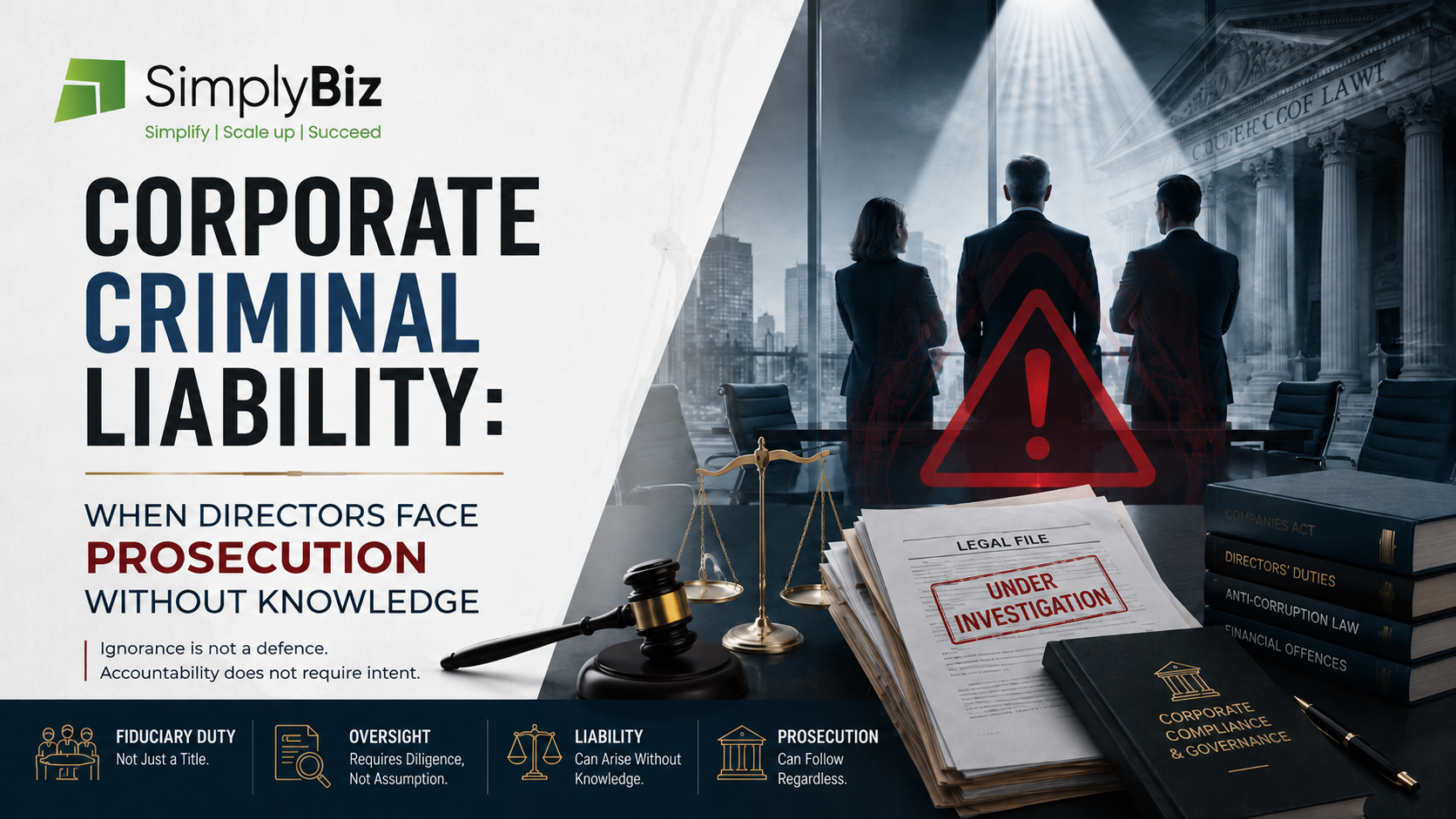
Under Indian corporate law, company directors face an unsettling reality: they can be held criminally liable for offenses committed by their company, even without actual knowledge of the wrongdoing. This principle of vicarious criminal liability has emerged through statutory provisions and judicial interpretations aimed at ensuring corporate accountability. For directors, ignorance offers no protection, and merely holding office can expose them to prosecution.
The Legal Framework
Directors’ criminal liability in India rests on provisions across multiple statutes including Section 141 of the Negotiable Instruments Act, 1881, the Companies Act, 2013, the Income Tax Act, 1961, the GST Act, 2017, and the Insolvency and Bankruptcy Code, 2016. These provisions follow a common structure: when a company commits an offense, every person who was in charge of and responsible for the conduct of business at the time is deemed guilty, unless they can prove they had no knowledge or exercised due diligence.
Section 141 of the Negotiable Instruments Act is archetypal. It creates a statutory presumption of guilt that shifts the burden of proof onto the accused director. The Supreme Court has clarified in cases like S.M.S. Pharmaceuticals Ltd. v. Neeta Bhalla (2005) that specific averments indicating the director’s role are required for prosecution. However, this does not mean actual knowledge is necessary.
The Knowledge Paradox
The paradox lies in the interplay between two principles. Directors must be “in charge of and responsible for” the business, yet prosecution is permitted without proving actual knowledge. Courts have interpreted “in charge of” broadly to include managing directors, executive directors, and non-executive directors with specific responsibilities.
In Sharad Kumar Sanghi v. Sangita Rane (2015), the Supreme Court held that directors can be deemed in charge even without awareness of particular transactions, provided they held positions of responsibility. This creates situations where a director overseeing financial operations could face prosecution for dishonoured checks issued by subordinates, even without approval or knowledge. The law presumes that someone “in charge of” a function should have known about activities within it.
Specific Statutory Provisions
The Companies Act, 2013 contains numerous provisions imposing criminal liability on “officers in default,” defined in Section 2(60) to include managing directors, whole time directors, and specified officers. Directors can face prosecution based on their positions rather than proven knowledge of violations.
The Prevention of Money Laundering Act, 2002 takes a stringent approach under Section 70, where every person in charge of business when an offense occurs is deemed guilty. Combined with aggressive enforcement, directors face serious charges with minimal evidence of personal involvement.
Tax statutes allow prosecution of directors for company tax evasion even when actual evasion was carried out by subordinates without directors’ knowledge, provided directors were responsible for tax compliance.
The Insolvency and Bankruptcy Code: A Critical Dimension
The Insolvency and Bankruptcy Code, 2016 (IBC) represents perhaps the most significant evolution in directors’ criminal liability, targeting directors for actions that may have occurred without their direct knowledge but within their sphere of responsibility.
Section 66: Fraudulent Trading imposes criminal liability on persons knowingly party to business conducted with intent to defraud creditors. Courts interpret “knowing” broadly to include situations where directors should have known given their positions. Directors face imprisonment up to five years and fines up to five times the amount involved. The provision covers pre-insolvency conduct, meaning directors unaware of specific fraudulent transactions but who failed to establish oversight mechanisms may face prosecution once the company enters insolvency.
Section 69: Transactions Defrauding Creditors targets undervalue or preferential transactions prejudicing creditors. Directors who approved transactions believing them commercially justified can face criminal liability if later deemed fraudulent. Transactions undertaken in normal business course may, with hindsight during insolvency, be characterized as defrauding creditors.
Section 70: Wrongful Trading introduces personal liability. When liquidation reveals business was carried on to defraud creditors, the Adjudicating Authority may declare persons knowingly party to such conduct personally liable for company debts. Courts have held that willful blindness or reckless disregard constitutes knowledge. Directors who failed to attend meetings discussing financial distress, ignored deteriorating financial statements, or continued approving expenditures while unable to meet obligations may be held personally liable. This pierces the corporate veil, potentially costing directors personal assets.
Section 75: General Penalty provides imprisonment up to three years or fines up to five lakh rupees for contraventions without specific punishment provisions. Directors face prosecution for various non-compliance issues, including failure to cooperate with resolution professionals or non-disclosure of assets, even when unaware of deficiencies.
The IBC intersects with other criminal laws, compounding liability. Directors of companies in insolvency may simultaneously face charges under the Companies Act, PMLA, Prevention of Corruption Act, and Indian Penal Code for the same conduct, each with different knowledge standards and defenses.
When companies enter insolvency, resolution professionals investigate their affairs and may file criminal complaints based on discovered irregularities. Directors face significant information asymmetry—resolution professionals access all records while directors, no longer in control, must defend themselves without complete information. What appeared as legitimate business decisions can seem suspicious through the lens of subsequent insolvency.
Judicial Safeguards and Due Diligence Defense
Courts have developed safeguards recognizing the harsh implications. The due diligence defense allows directors to escape liability by proving they exercised all due diligence to prevent the offense, though the burden lies on the accused.
In N.K. Wahi v. Shekhar Singh (1977), the Supreme Court required directors to show specific preventive steps, not merely general management systems. This includes evidence of regular audits, compliance programs, specific instructions to subordinates, and personal supervision. Generic delegation claims typically fail.
Maksud Saiyed v. State of Gujarat (2008) clarified that technical or nominal directors genuinely lacking day-to-day management roles should not be prosecuted. However, proving nominal status requires concrete evidence, and courts remain sceptical, particularly when directors signed important documents or attended board meetings.
Practical Challenges
Directors face multiple challenges. First, the sheer volume of regulatory requirements across statutes makes comprehensive compliance extraordinarily difficult. Second, in large organizations, directors cannot personally oversee every transaction yet remain accountable for subordinates’ actions. Third, nominee directors appointed by banks or institutions face particular vulnerability despite lacking operational control.
The IBC creates specific challenges for directors of distressed companies who must simultaneously rescue the company while protecting themselves from criminal liability. Every decision about assets, payments, or operations carries risk requiring detailed contemporaneous records.
Recent Developments
Recent years have seen increased prosecutions driven by enhanced enforcement and the IBC regime. Resolution professionals routinely file criminal complaints against former directors to maximize creditor recoveries. While courts sometimes temper vicarious liability as in Sunil Bharti Mittal v. Central Bureau of Investigation (2015), dismissing charges without evidence of mens rea this trend hasn’t been uniform in IBC cases where pressure to hold individuals accountable has led to aggressive prosecutions.
Data analytics and forensic investigations in insolvency proceedings have made uncovering potential misconduct easier, leading to more frequent criminal complaints even for conduct occurring years earlier.
Practical Recommendations
Directors must adopt proactive strategies including maintaining comprehensive documentation of board deliberations, obtaining independent professional advice on significant transactions, implementing robust compliance systems, conducting regular risk assessments, and ensuring proper disclosure.
Directors should maintain detailed board minutes recording their questions, concerns, and decision bases. Dissenting directors should ensure formal recording of dissent. Directors should obtain regular management certifications regarding compliance and information accuracy.
For potential insolvency situations, directors should document monitoring of financial position, evaluation of going concern assumptions, and consideration of stakeholder interests. If insolvency appears imminent, directors should seek specialized advice and document their consideration of voluntary insolvency proceedings.
Directors should maintain adequate directors’ and officers’ liability insurance, which typically covers defense costs even for misconduct allegations.
Conclusion
Vicarious criminal liability for directors under Indian law reflects a policy choice ensuring corporate accountability by making those in authority personally answerable for corporate wrongdoing. The IBC has significantly expanded this liability, creating new criminal offenses targeting directors and imposing potential personal liability for corporate debts. While serving important objectives in deterring corporate crime and protecting creditors, this creates a harsh regime where individuals face prosecution, imprisonment, and financial ruin for acts they did not personally commit or know about.
Directors must recognize that their positions carry substantial personal risk extending beyond their tenure. The due diligence defense requires proactive, documented compliance efforts. The IBC has particularly heightened risks for directors of financially distressed companies, where every decision faces intense scrutiny and potential prosecution.
Modern Indian directors must maintain meticulous oversight records, implement robust compliance systems, obtain regular legal and audit opinions, carefully monitor financial positions, and consider liability insurance. Once companies enter insolvency, directors may face prosecution based on investigations reconstructing conduct with hindsight and without full context.
As Indian corporate law evolves, particularly with maturing IBC jurisprudence, the balance between accountability and protecting individuals from unjust prosecution remains debated. What remains clear is that directorship in India carries significant legal exposure requiring constant vigilance, active engagement with compliance and financial obligations, and careful documentation of significant decisions. Directors can no longer claim ignorance as a shield, and the position demands the highest levels of attention, diligence, and professional conduct.
For expert guidance on Corporate Criminal Liability and the circumstances in which directors may face prosecution, connect with our team at shilpa@simplybiz.in.
Leave A Comment