

Businesses play an important role in shaping society, not just through economic growth but also by contributing to social and environmental well-being. Corporate Social Responsibility (CSR) is a framework that encourages companies to undertake initiatives that benefit the community and promote sustainable development.
What is CSR?
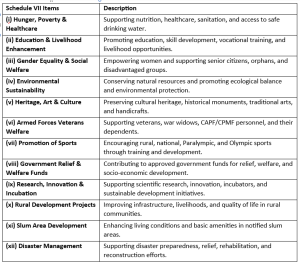
Corporate Social Responsibility (CSR) is a statutory obligation under Section 135 of the Companies Act, 2013 requiring eligible companies to contribute towards social, environmental, and economic development through activities specified under Schedule VII.
Who is Required to Comply with CSR?
CSR provisions apply to every company having, during the immediately preceding financial year:
- Net Worth of ₹500 Crore or more; or
- Turnover of ₹1,000 Crore or more; or
- Net Profit of ₹5 Crore or more.
When Does CSR Apply?
CSR obligations become applicable when a company meets any of the above thresholds in the immediately preceding financial year.
Once applicable, the company is required to:
- Formulate a CSR Policy;
- Constitute a CSR Committee (where applicable);
- Spend the prescribed CSR amount; and
- Make the necessary disclosures in the Board’s Report and annual filings.
What is the CSR Spending Requirement?
Eligible companies are required to spend:
At least 2% of the average net profits of the three immediately preceding financial years on CSR activities.
Activities Covered under Schedule VII
Why Statutory Obligations Cannot Be Counted as CSR
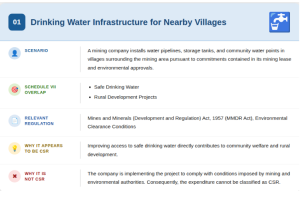
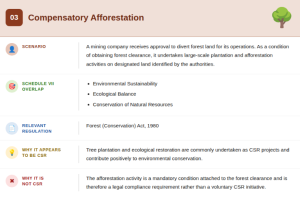
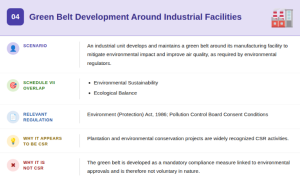
Corporate Social Responsibility (CSR) is often viewed as a company’s commitment to giving back to society. However, not every socially beneficial expenditure qualifies as CSR. One of the most important principles under the CSR framework is that activities undertaken merely to comply with statutory obligations cannot be treated as CSR activities with reference to FAQs on CSR by MCA (FAQ 4.1) vide Circular No. 14/2021 and the FAQs on CSR by ICSI (Q No. 13).
In simple terms, a company cannot claim credit for doing something that the law already requires it to do.
The Philosophy Behind the Rule
Imagine a company installs pollution-control equipment because environmental laws mandate it. While the equipment benefits society, the company is simply complying with the law. CSR is meant to encourage companies to go beyond what is legally required.
The Ministry of Corporate Affairs (MCA) has consistently emphasised that CSR should represent an additional contribution to society — not a cost of compliance.
“Compliance is what a company must do. CSR is what a company chooses to do for the greater good.”
The Mandatory vs. Voluntary Test
Whenever there is doubt, ask:
Is the activity being undertaken because the law requires it, or because the company voluntarily wants to create a positive social impact?
If the activity is mandatory – it is compliance. Not eligible as CSR.
If the activity is voluntary and falls within Schedule VII – it may qualify as CSR.
MCA Clarifications
The MCA has issued several clarifications reinforcing that expenditure incurred for statutory compliance cannot be treated as CSR activities. The rationale is straightforward: if mandatory compliance costs were allowed as CSR expenditure, companies could satisfy CSR requirements without making any additional contribution to society. Such an interpretation would defeat the very purpose of CSR.
Why This Distinction Matters
Incorrect classification of statutory expenditure as CSR can lead to:
- Non-compliance with CSR provisions.
- Inaccurate CSR disclosures.
- Questions from auditors and regulators.
Therefore, companies should carefully evaluate the purpose behind every expenditure before including it in their CSR spend.
Activities imposed by Statutory Authorities that overlap with Schedule VII of Companies Act, 2013



Conclusion
CSR is intended to create value for society beyond the minimum standards imposed by law. Compliance is a legal duty; CSR is a social commitment. While both are important, they serve different purposes.
The true spirit of CSR lies not in meeting legal requirements, but in going beyond them to make a meaningful and lasting impact on society.
“Compliance is what a company must do. CSR is what a company chooses to do for the greater good.”
Leave A Comment