
Contributed by: Medha Srada
Email – Medha@simplybiz.in
Background – What is NBFC?
A Non-Banking Financial Company (NBFC) is a Company registered under the Companies Act that is engaged in the business of loans and advances, acquisition of shares, or leasing and hire-purchase but which does not carry on agricultural, industrial, or goods-trading activity as its principal business. To qualify as a NBFC, an entity must satisfy the “50 percent rule”. Which means, its assets and income from the financial activity should exceed 50 percent of its total assets (netted off by intangible assets) and gross income.
RBI has introduced Master Direction on (Non-Banking Financial Company – Scale Based Regulation) Directions, 2023, wherein Regulatory structure for NBFC comprised of four layers based on their size, activity and risk.
- NBFCs – Base Layer
- NBFCs – Middle Layer
- NBFCs – Upper Layer and
- NBFC – Top Layer
Objective of the Reserve Bank of India (Non-Banking Financial Companies – Registration, Exemptions and Framework for Scale Based Regulation) Amendment Directions, 2026 (2026 Amendment Direction)
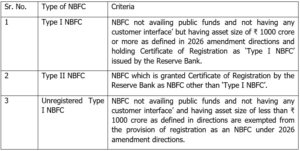
The 2026 amendment reflect RBI’s view that not every NBFC presents the same degree of systemic or consumer-facing risk. Hence the amendment direction introduced below categories of NBFCs
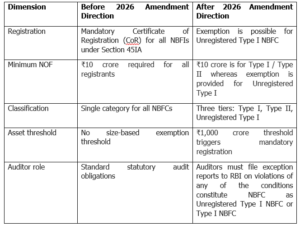
 What Changed: Pre and post 2026 Amendment Direction:
 Existing registered entities in the exempted category are given a limited window of 6 months to seek deregistration. The exemption is given to lower the burden of compliance of NBFCs having no exposure to public funds and to focus on the NBFCs which accepts public funds and has customer interface from the broader policy of “ease of compliance”.
Eligibility Criteria for Exemption/Deregistration
- The NBFC must not avail public funds
- The NBFC must not have any customer interface
- Its asset size must be below ₹1,000 crore as per the latest audited balance sheet
Note: “Public funds” is understood broadly to include bank borrowings, market borrowings, debentures, commercial paper and other external funds, while the absence of “customer interface” reflects that the exemption is intended for entities not engaged in financial dealings with the public at large.
Procedure and Timeline for De-registration:
Eligible NBFC should –
- File an application through the RBI’s PRAVAAH portal
- Documents – De-registration application, Original COR, audited financial statements for the last three years, statement on public funds and customer interface, a statutory auditor’s certificate, and the requisite Board resolution.
- On or before 31st December 2026
Continuing Obligations and Restrictions
- The exemption is not unconditional and is subject to continuing compliance requirements.
- An exempt entity must seek appropriate registration as a Type I or Type II NBFC (as applicable) if it:
- Avails public funds;
- Acquires customer interface; or
- Crosses the ₹1,000 crore asset threshold.
- Where multiple Unregistered Type I NBFCs exist within a Group, their asset sizes are aggregated for the purpose of the ₹1,000 crore threshold.
- Statutory auditors must submit an exception report to the RBI in case of any violation of the exemption conditions.
- The Company’s Board of Directors must annually confirm continued compliance with the exemption conditions.
- An Unregistered Type I NBFC intending to undertake overseas investment in the financial services sector must still seek registration and regulatory approval from RBI.
- Unregistered Type I NBFCs are prohibited from making overseas investment in the non-financial sector.
Conclusion
The 2026 amendment direction to the RBI’s scale-based regulation framework is a practical step towards proportional regulation, relieving non-public-fund NBFCs from mandatory registration while preserving supervisory discipline through disclosure, Board oversight and re-registration triggers. Eligible NBFCs should carefully examine the prescribed conditions and complete the deregistration process within the statutory timeline in order to benefit from this relief.
Disclaimer: This article is intended solely for informational purposes and is based on the RBI’s Amendment Directions dated 29 April 2026. Readers are advised to seek professional advice before taking any action based on the contents of this article.
For expert guidance on RBI’s 2026 Scale Based Regulation Amendments: Regulatory Relief and Deregistration of Certain NBFCs , connect with our team at Vaishali@simplybiz.in & Vanaja@simplybiz.in.
Leave A Comment