
Everything You Need to Know About Director Identification Number (DIN)
contributed by : Kaushik Roy
Email: kaushik@simplybiz.in
What’s the big deal about a DIN?
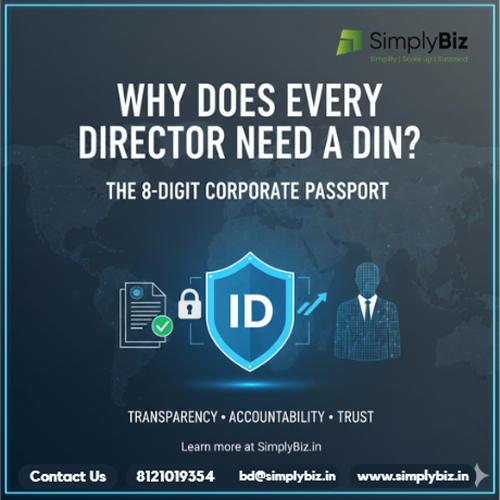
In today’s corporate world, the role of a company director carries immense responsibility—ranging from fiduciary duties and legal compliance to upholding the highest standards of governance. To ensure transparency and accountability among thousands of directors across India, every director is issued a unique Director Identification Number or DIN—an 8-digit corporate passport that acts as a badge of authenticity and trust.
The DIN is more than just a number. It is a permanent, non-transferable identifier that remains with a director throughout their career, regardless of the companies they serve. This lifelong identity ensures the Ministry of Corporate Affairs can trace a Director’s footprint throughout the corporate landscape, revealing appointments, resignations, service history and more to investors, regulators and the vigilant public.
In a world before DINs, it was hard for regulators and companies to verify who really was in charge, could sneak into boardrooms under different aliases or with slightly tweaked details, creating confusion and opportunities for fraud. The current system is designed to prevent misuse of identity, fraud, and confusion that were once common when directors could operate under different names or details.
With DINs, there is now a clear, reliable record that investors, regulators, and the public can access for due diligence and compliance assurance.
How to Obtain Your DIN
Regardless of whether you are about to walk into a boardroom for the first time or you’re making a return after a while away, getting your DIN is straightforward:
1. For newly incorporated companies, up to three first-time directors can obtain DINs through the SPICEe+ form.
2. For individuals joining existing Companies, a DIN has to be obtained by filling out the DIR-3 e-form on the MCA website. Be sure however, to keep the following handy:
-ID Proof
-Address Proof
-Photograph
-Digital signature and verification from an existing Director or a Professional i.e. CS/CA/CMA
The entire process is digital, designed to be quick and user-friendly, encouraging prompt compliance. Once the requisite data has been furnished, the Ministry verifies your information and issues a DIN. This happens fairly quickly, unless something is missing or incorrect.
Legal Parlance
We have mentioned that an individual can only have One (1) DIN issued to them. Let’s have a look what the law says about it.
Section 155 Companies Act 2013 states that, no individual may be allotted more than one DIN and Section 159 further drives the point home by prescribing a penalty which may extend to INR 50,000. Additionally, in cases where the default continues, an extra INR 500 per day on top of the original fifty thousand is also imposed.
As an example, here is a copy of an order passed by the ROC PO/ADJ/09-2025/HD/00681 where a person was found to be in possession of Two (2) DINs in contravention of Section 155. The Director in question had multiple DINs. One issued on 01.07.2006 and another issued on 21.08.2009. The application for surrender of the DIN issued on 21.08.2009 was made on 27.05.2025, which amounted to a default of 5,393 days. As a result, the penalty imposed on the concerned party was Rs. 27,46,500 (Twenty-Seven Lakhs Forty-Six Thousand and Five Hundred Only), which was payable within 90 days from the date of the order so passed. Failure to pay within the stipulated time, also has consequences as provided in HYPERLINK “https://ca2013.com/454-adjudication-of-penalties/”Section 454(8)..
If the authorities spot any fraud, false information, or misuse linked to your DIN, they can deactivate/suspend it and bar you from holding directorships in any company.
Surrendering a DIN
What should you do if you somehow find yourself in possession of Two (2) DINs? No problem! That’s something that can easily be fixed.
In such a case, simply file a Form DIR-5 and apply to surrender one of them. Usually, the newest DINs must be surrendered.
How many Directorships can you hold?
Section 165 of the Companies Act restricts the maximum number of directorships per DIN to 20 companies, including no more than 10 public companies, ensuring directors are not overstretched and remain accountable.
The DIN system enforces this limit, preventing directors from appearing under multiple aliases.
Public Transparency
Public transparency is a hallmark of the DIN system: anyone can access a director’s master data online, reviewing current and past directorships, appointment and cessation dates, and company status. This openness strengthens trust within the corporate ecosystem.
DIN KYC aka Annual Health check
Each year, between April 1st and September 30th, you need to check in digitally with the MCA to confirm your details: name, address, mobile number, and email. This is called DIR-3 KYC. If you miss it, your DIN gets “deactivated”—meaning you’re not legally allowed to act as a director anywhere until you fix it (and pay a late fee!).
There’s now a quick web-based KYC option, which certainly makes the filing easier than before.
Steps to Reactivate a Deactivated DIN
If your DIN is deactivated (usually due to missing DIR-3 KYC or non-compliance):
• First, find out the reason on the MCA portal.
• File the relevant compliance form (most often DIR-3 KYC with a late fee).
• In rare cases, if you were disqualified, you may need to wait for a prescribed period or get a court order for restoration.
• After your application, MCA will validate and generally reactivate your DIN if everything is in order.
Professional Services and DIN Verification
Lawyers, banks, auditors, and even HR agencies now routinely use DIN verification APIs or tools to check:
• Whether your DIN is active
• Your identity and history
• Mandated compliance (like no dual DINs, KYC status, etc.)
Failing DIN checks can delay funding, licensing, or other important business steps.
DIN Across Continents
Foreign nationals joining Indian boards must get a DIN and complete all paperwork (sometimes requiring extra attestation, notary, or apostille steps). While DIN is mandatory for directorship actions in India, it complements other government IDs like PAN but does not replace them.
The Bottom Line
Director Identification Number is the cornerstone of India’s corporate compliance regime—ensuring clear identification, preventing fraud, enabling oversight, and fostering good governance. For every director, maintaining an accurate and active DIN is not just a legal formality but a professional obligation that safeguards the integrity, reputation, and legal standing of themselves and the companies they serve.
And there you have it! Everything you need to know about DINs and Directors in one place.
At SimplyBiz, we offer comprehensive and end to end management of Corporate Governance & Secretarial Compliances covering all stages of entity life cycle. If you want to know more on the DIN related requirements, please write to our Product Head – Vaishali Vohra at the mail ID vaishali@simplybiz.in Lead – Corporate Compliances at vanaja@simplybiz.in or SimplyCorp@simplyBiz.in
Leave A Comment